

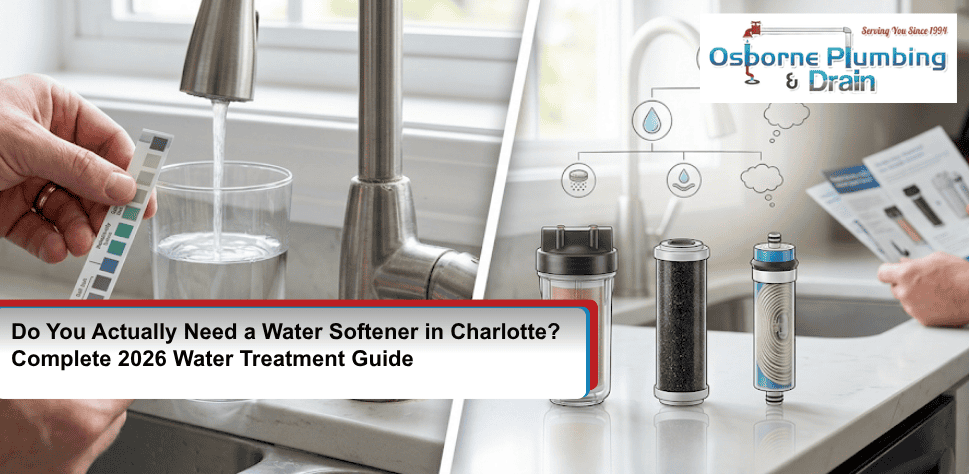
Most homes receiving Charlotte Water do not automatically need a traditional water softener because current treated water measures about 35 ppm total hardness, which is relatively soft. You may still benefit from filtration if you want to address chlorine taste, sediment, an older home’s plumbing, or a specific contaminant found through testing. Test first, identify the problem, then choose the treatment technology that actually addresses it.
You notice white spots on a shower door, the refrigerator water tastes different, or someone tells you that every Charlotte home needs a water softener. Before spending several thousand dollars, there is one question worth answering first: what problem are you actually trying to solve?
Homeowners searching for water softener companies near me often assume softening and filtration are the same thing. They are not. A softener targets calcium and magnesium. Carbon filtration addresses concerns such as chlorine taste and odor. Sediment filters catch particles. Reverse osmosis, or RO, treats drinking water through a specialized membrane.
That distinction matters in Charlotte. Charlotte Water’s June 2026 mineral analysis reported total hardness of only 35 parts per million, which is roughly 2 grains per gallon and relatively soft water.
This guide explains how to choose between softening, whole house filtration, carbon, sediment, and reverse osmosis based on your actual water.
Does Charlotte Water Actually Need Softening?
A water softener solves one main problem: hardness.
Hardness comes primarily from dissolved calcium and magnesium. Traditional ion-exchange softeners pass water through resin beads that exchange those minerals for sodium or potassium ions.
EPA notes that softeners can reduce scale and improve soap performance in areas with hard water. They also require regeneration, which uses salt and additional water.
What Charlotte’s Current Numbers Show
Charlotte Water’s June 2026 mineral analysis reported:
- Total hardness: 35 ppm
- Calcium: 11 ppm
- Magnesium: 2 ppm
- Sodium: 4.4 ppm
- pH: 8.69
At about 2 grains per gallon, that is not the classic hard-water profile that automatically justifies an ion-exchange softener.
That means a homeowner searching for water softener Charlotte NC service should test before buying.
Match the System to the Problem
| Your Concern | Better Starting Option |
| Heavy calcium scale | Water softener |
| Chlorine taste or odor | Activated carbon |
| Rust, sand, visible particles | Sediment filter |
| Drinking-water contaminant reduction | Certified carbon or RO |
| Treatment at every fixture | Whole house filtration |
| Highly purified kitchen drinking water | Point-of-use RO |
Pro Tip: Do not buy a softener because your shower glass has a few spots. Test hardness first. Soap residue, plumbing sediment, and evaporation can also leave visible deposits.
Warning Signs That Tell You Which Water Treatment You Need
The symptom matters because different systems remove different things.
A water softener repair Charlotte NC company cannot fix a chlorine taste by adding more salt. Likewise, a carbon filter will not truly soften hard water.
Watch for these clues:
- Thick white scale on fixtures: Test hardness before considering a softener.
- Strong chlorine taste or smell: Activated carbon may be the more appropriate solution.
- Brown or reddish particles: Sediment or corrosion inside private plumbing may be involved.
- Cloudy water that clears after sitting: This may simply be trapped air, not contamination.
- Metallic taste in an older home: Test the water and inspect older faucets, solder, and piping.
- Only drinking water is a concern: A point-of-use carbon or reverse osmosis system may cost less than treating the entire house.
- Water quality changes only at one faucet: The problem may be the faucet, aerator, supply line, or local plumbing rather than the municipal supply.
Charlotte Water recommends flushing cold water and cleaning faucet aerators when discoloration occurs. Persistent problems should be reported to the utility or evaluated by a plumber.
Warning: Do not assume an unusual taste or color proves your municipal water is unsafe. Water quality problems can originate inside your home’s plumbing. Test before selecting treatment.
What Happens When You Install the Wrong Water Treatment System
Water treatment equipment works best when it solves a measured problem. Oversizing or choosing the wrong technology adds cost, maintenance, and sometimes unnecessary water use.
For example, installing a traditional softener on already soft municipal water can create expenses for salt, regeneration, cleaning, and eventual repair without solving chlorine taste.
A whole house reverse osmosis system can also be excessive when your main goal is better drinking water at the kitchen sink.
Common Water Treatment Mistakes
- Buying a softener for taste: Hardness and taste are different issues.
- Installing carbon to remove hardness: Carbon does not function as a traditional water softener.
- Buying RO without checking certification claims: Different RO systems are certified for different contaminant reductions.
- Skipping sediment prefiltration: Particles can shorten the life of downstream filters.
- Oversizing equipment: Larger is not automatically better.
- Ignoring flow rate: An undersized whole house filter can restrict water pressure.
- Skipping filter changes: An overdue filter cannot perform as designed.
EPA specifically notes that cation-exchange softeners consume water during regeneration and require salt. Efficient sizing matters.
Choosing correctly starts with a water quality test Charlotte NC homeowners can use to separate hardness, aesthetic concerns, and actual contaminant concerns.
If your water tastes different, leaves deposits, or your existing treatment equipment is failing, Osborne Plumbing & Drain can evaluate the plumbing and treatment setup. Call (704) 606-5971 for clear options before replacing equipment you may not need.
DIY Water Testing vs. Hiring a Licensed Plumber
You can learn quite a bit before calling a water softener installer Charlotte homeowners use.
What You Can Handle
- Read Charlotte Water’s current report. Start with the public data for your municipal supply.
- Use a hardness test strip. This gives you a quick estimate of calcium and magnesium levels.
- Compare multiple faucets. A problem at one fixture may point to plumbing rather than source water.
- Remove and inspect aerators. Sediment collected there can reveal corrosion or debris.
- Check your existing filter date. Many taste complaints begin when a carbon cartridge is overdue.
- Identify your goal. Decide whether you want scale reduction, improved taste, particle removal, or drinking-water treatment.
When You Must Call a Pro
Call a licensed plumber when treatment requires cutting into the home’s potable water line, installing a bypass, adding drains, changing valves, correcting pressure issues, or modifying existing plumbing.
North Carolina licensing rules specifically address water filtration systems connected to potable water distribution or service piping. Homeowners should verify contractors through the North Carolina State Board of Examiners of Plumbing, Heating & Fire Sprinkler Contractors.
Professional installation is especially important for a whole house water filter Charlotte NC home because the equipment must maintain adequate flow and avoid contamination risks.
Do Not Do This: Do not select equipment only from a salesperson’s generic water test. Ask what was measured, request the result in ppm or grains per gallon, and compare it with your utility’s published data.
How Professional Water Treatment Installation Works
Good water treatment begins with diagnosis, not a product catalog.
Step 1: Discuss Your Water Concerns, 10 to 15 Minutes
The plumber asks about taste, odor, scale, staining, drinking-water goals, existing equipment, and whether the home uses municipal or private well water.
Step 2: Test the Water, 15 to 45 Minutes
Testing may cover hardness, pH, iron, sediment, total dissolved solids, chlorine, or a more specific contaminant concern.
Step 3: Inspect Plumbing and Flow, 20 to 40 Minutes
The technician checks pipe size, pressure, shutoff valves, available drainage, electrical access when required, and the best treatment location.
Step 4: Match Technology to the Result, 15 to 30 Minutes
The recommendation might be:
- Sediment prefilter
- Activated carbon filtration
- Traditional ion-exchange softener
- Whole house filtration
- Point-of-use reverse osmosis
- A combined treatment train when justified
Step 5: Install the System, 2 to 8 Hours
A basic under-sink system may take a few hours. Whole house water filtration installation Charlotte projects often require more plumbing work.
Step 6: Flush and Test
The plumber checks pressure, leaks, bypass operation, drain connections, and treated-water quality.
Step 7: Explain Maintenance
You should know when to replace cartridges, add salt, sanitize the system, change an RO membrane, and schedule water softener maintenance Charlotte service.
Plumber’s Advice: Look for certified performance claims. NSF/ANSI 42 addresses aesthetic effects such as chlorine taste and odor, NSF/ANSI 53 addresses certain health-related contaminant claims, and NSF/ANSI 58 covers reverse osmosis systems.
Water Softener and Filtration Costs in Charlotte NC in 2026
Pricing depends on system type, household demand, plumbing access, flow rate, equipment quality, and whether new drain or electrical connections are needed.
Price factors include:
- Pipe size and access
- System flow capacity
- Number of people in the home
- Water test results
- Existing bypass valves
- Drain access
- Filter media quality
- Electrical requirements
- Removal of old equipment
- Emergency versus scheduled service
A legitimate estimate should identify equipment, labor, plumbing modifications, startup, cleanup, warranty, filter schedule, and expected ongoing costs.
Red flags include a quote with no water test, no model information, no certification claims, or no explanation of why the system matches your water.
Financing may make sense for larger combination systems. The best price still comes from an in-home assessment rather than buying equipment from hardness assumptions alone.
How to Choose Water Softener Companies Near Me
Search results for water softener companies near me can include plumbers, water-treatment specialists, franchises, equipment dealers, and general home-service businesses.
The best choice is the company that diagnoses your water before selling the equipment.
Ask these questions:
- What is my measured hardness in ppm or grains per gallon?
- Why are you recommending this technology?
- Which contaminants or aesthetic issues is the unit certified to reduce?
- Is the equipment NSF or another accredited third-party certified?
- What flow rate will the system support?
- How often are filters or membranes replaced?
- How much salt and regeneration water does the softener use?
- Who performs warranty service?
- Is the installer properly licensed in North Carolina?
- Will I receive written pricing before installation?
Look for general liability insurance and appropriate licensing. PHCC membership, BBB accreditation, and established Google or Nextdoor reviews may provide additional trust signals.
Manufacturer experience can also matter with treatment equipment, fixtures, water heaters, and connected plumbing systems. Ask about brands, parts availability, warranty support, and local service.
Local companies have another advantage. A plumber serving Charlotte, Matthews, Pineville, Huntersville, Belmont, Gastonia, Cornelius, and Mount Holly can compare your home’s result against local municipal conditions rather than assuming Charlotte has the same water as another state.
The best water softener service near me should sometimes tell you that you do not need a softener.
Seasonal Water Treatment Maintenance in Charlotte
Water treatment systems need maintenance even when the incoming municipal water meets standards.
Charlotte summers create high household water demand through guests, laundry, outdoor activity, and irrigation. Filters that were sized for light usage can reach capacity faster.
As of August 2026, Charlotte Water’s public site also lists Mandatory Stage 2 water restrictions. That makes efficiency worth considering when choosing equipment that uses regeneration or reject water.
Annual Water Treatment Checklist
- Test water hardness before adjusting a softener.
- Check salt level and salt bridging in existing softeners.
- Replace sediment cartridges on schedule.
- Replace carbon filters according to manufacturer capacity.
- Sanitize filter housings during cartridge changes.
- Check RO pressure and storage tank performance.
- Replace RO membranes based on testing and manufacturer guidance.
- Inspect bypass valves for leaks.
- Review water pressure after whole house filters.
- Retest water if taste, odor, staining, or source conditions change.
A point-of-use RO system creates a treated water stream and a reject water stream. EPA’s newer WaterSense criteria encourage more efficient RO designs, so efficiency ratings are worth comparing.
Preventive maintenance is usually much less expensive than replacing a fouled membrane, damaged control valve, or neglected treatment system.
Schedule water softener maintenance Charlotte service before a failure if the unit stops regenerating correctly, water feels noticeably different, or salt consumption suddenly changes.
Charlotte Water Quality Factors That Should Guide Your Choice
The most important local SEO fact for this topic is also the most useful homeowner advice: Charlotte’s municipal water is currently relatively soft.
Charlotte Water’s latest mineral analysis lists 35 ppm total hardness.
That means a water softener installation Charlotte NC homeowner should generally be based on a measured household need, not a belief that all Charlotte water is hard.
Charlotte Water’s 2025 report also says its water met drinking-water standards with zero violations. The utility performed more than 183,000 tests during the year.
Charlotte’s current treatment process starts with water from Mountain Island Lake and Lake Norman. The utility uses powdered activated carbon for taste and odor control, filtration, chlorine for bacterial control, fluoride, and lime for pH adjustment.
That matters when selecting home treatment. The current report describes chlorine, not chloramine, as its disinfectant. A homeowner should not pay for a chloramine-specific treatment system solely because someone assumes every municipal supply uses chloramine.
Home plumbing can still change water at the tap. Charlotte Water specifically notes that older faucets, fittings, solder, and internal plumbing may affect lead exposure.
No current Charlotte Water program found in the reviewed public materials provides a universal residential rebate specifically for installing a softener or whole house filter. Verify current programs directly before relying on a rebate in your budget.
Homeowners Also Ask About Charlotte Water Treatment
Is Charlotte NC water hard or soft?
Charlotte Water’s June 2026 mineral analysis reported total hardness of 35 ppm, or roughly 2 grains per gallon. That is relatively soft water. Most municipal customers therefore should not assume they need a traditional salt-based softener. Test your home’s water if you have unusual deposits, a private well, or a specific concern.
Is a whole house water filter better than a water softener?
They solve different problems. A softener removes hardness minerals such as calcium and magnesium. A whole house water filter can target sediment, chlorine, taste, odor, or specific contaminants depending on its media and certification. Some homes need one system, some need both, and many Charlotte municipal customers may need neither.
Is reverse osmosis worth it in Charlotte?
RO can make sense when your goal is highly treated drinking and cooking water or reduction of a specific contaminant covered by the system’s certification. Point-of-use reverse osmosis installation Charlotte NC service is usually more practical than whole house RO for municipal water. Always check the NSF/ANSI 58 contaminant claims for the exact model.
Does a carbon filter soften water?
No. Activated carbon adsorbs certain chemicals and is commonly used to improve chlorine taste and odor. It does not remove calcium and magnesium the way an ion-exchange softener does. If a salesperson describes a carbon filter as a true water softener, ask for clarification and certified performance data.
Should I test Charlotte tap water before buying filtration?
Yes. Start with Charlotte Water’s current public report, then test your individual home if you have a specific concern. Plumbing materials, private wells, localized sediment, old fixtures, and treatment equipment can affect water after it enters the property. Testing helps you avoid buying unnecessary equipment.
Frequently Asked Questions
Q: How much does water softener installation cost in Charlotte?
A: Current 2026 market estimates put many Charlotte installations near $1,500, but simple systems may cost less and large dual-tank or specialized systems can cost several thousand dollars. Plumbing modifications, capacity, brand, bypass valves, drainage, and installation complexity all affect the price. Get an in-home estimate before choosing equipment.
Q: How long does water softener installation take?
A: A straightforward installation may take two to three hours when the plumbing and drain location are ready. Whole house filtration or combination systems may require four to eight hours or longer. Older plumbing, tight access, new valves, drain work, or electrical changes can extend the job.
Q: Do I need a licensed installer for a whole house water system?
A: Whole house equipment connects directly to potable water piping, so proper plumbing and sanitation matter. North Carolina rules address licensed work involving water filtration systems connected to distribution and service piping. Verify the contractor through the North Carolina State Board of Examiners before approving installation.
Q: How often does a water softener need service?
A: Check salt levels regularly and inspect system performance at least annually. Maintenance frequency depends on water usage, hardness, resin condition, salt type, and control-valve design. If salt use suddenly rises, the water becomes harder, or regeneration becomes frequent, schedule water softener repair near me service.
Q: How often should whole house filters be changed?
A: There is no universal interval. Sediment and carbon filter life depends on cartridge size, water usage, contaminant load, and manufacturer capacity. Some require replacement every few months while larger media systems last much longer. Follow pressure drop, rated capacity, and manufacturer instructions rather than relying only on the calendar.
Q: Does Osborne Plumbing & Drain install water treatment systems outside Charlotte?
A: Osborne Plumbing & Drain serves Charlotte and surrounding communities including Belmont, Cornelius, Gastonia, Huntersville, Matthews, Mount Holly, and Pineville. Homeowners can request evaluation for water filtration, softener systems, connected plumbing, repairs, and maintenance by calling the office for current availability.
Get the Water Treatment Your Home Actually Needs
You should not have to buy a water softener simply because someone says Charlotte has hard water.
Osborne Plumbing & Drain can help you evaluate your water, plumbing, and treatment goals before recommending water softener installation Charlotte NC service, whole house filtration, carbon, sediment filtration, or reverse osmosis.
Our family-owned team provides licensed and insured plumbing service, upfront options, local experience, and a 100 percent satisfaction-focused approach.
Call (704) 606-5971 to schedule a water-treatment evaluation in Charlotte, NC, Matthews, Pineville, Huntersville, Belmont, Gastonia, Cornelius, Mount Holly, and surrounding communities.
Get the right treatment for your water, not simply the biggest system available.