

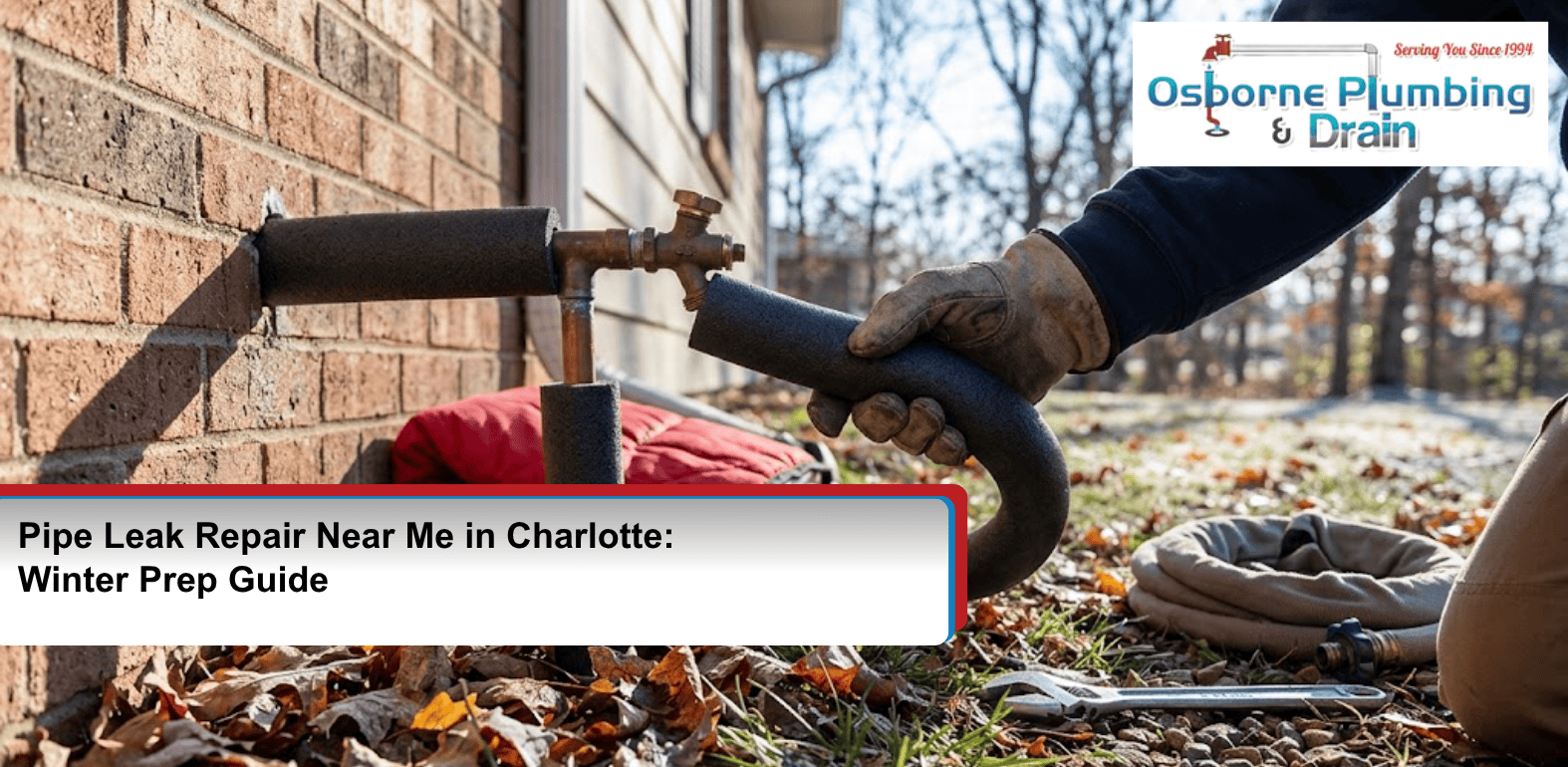
Check pipes in crawl spaces, garages, exterior walls, attics, utility rooms, outdoor kitchens, and areas serving hose bibs first. Look for active leaks, corrosion, cracked fittings, missing insulation, and pipes exposed to outside air. Repair damaged sections before insulating them because insulation cannot fix a defective pipe. If you see recurring leaks, galvanized piping, or widespread corrosion, ask a licensed plumber whether partial or whole-home repiping makes more sense.
A Charlotte afternoon can feel warm enough for short sleeves in October, then the overnight forecast suddenly drops toward freezing. That is when the pipe behind an outdoor faucet, under a drafty crawl space, or along an uninsulated garage wall becomes the weak point you wish you had checked earlier.
If you are already searching for pipe leak repair near me, do not wait for the first hard freeze to expose a damaged connection. Small leaks, corrosion, cracked fittings, and poorly insulated lines are easier to repair while the pipe is still accessible and dry.
National Weather Service records show Charlotte has experienced its first 32°F or lower temperature as early as October 9. That makes late September and October a practical time for a 2026 pre-winter plumbing inspection.
This guide explains which pipes to inspect, which ones to insulate, when repair is enough, and when plumbing pipe replacement Charlotte NC homeowners schedule may be the smarter long-term move.
Which Pipes Freeze First in Charlotte and Why?
A pipe does not have to be outdoors to freeze. The highest-risk pipes are usually the ones exposed to cold air or located far from the home’s heated envelope.
Charlotte Water specifically recommends extra preparation when temperatures remain below freezing after an overnight freeze.
Crawl-Space Pipes
Many Charlotte-area homes have crawl spaces. Water lines running below the floor can become vulnerable when vents, foundation openings, or damaged insulation allow cold air to move around the pipe.
Inspect these lines for:
- Missing or torn insulation
- Green or white corrosion around fittings
- Slow drips
- Previous repair couplings
- Pipes sitting directly against exterior vents
Outdoor Faucets and Hose Bib Lines
The faucet outside may look fine while the pipe behind it has already started to split.
Disconnect garden hoses before freezing weather. A connected hose can trap water and increase freeze risk around the outdoor faucet.
Garage and Exterior-Wall Plumbing
Laundry lines, utility sinks, water heaters, and bathrooms beside an unheated garage deserve attention. Pipes inside exterior walls may receive less indoor heat than plumbing near the center of the home.
Attic and Bonus-Room Plumbing
Some renovations route supply lines through attic spaces, knee walls, or bonus-room cavities. These locations can cool rapidly.
Pro Tip: Before buying pipe insulation, run your hand along the pipe and fittings. If you find moisture, rust, green corrosion, or a previous patch, schedule pipe leak repair near me service first.
Warning Signs Your Pipes Need Attention Before Cold Weather
You do not need to see a burst pipe to know a line is becoming unreliable. Weak pipes often provide warning signs months before freezing weather arrives.
Use these checks during a pre winter plumbing inspection that Charlotte, NC homeowners can complete before October ends:
- Water stains beneath a pipe. Brown or yellow staining can indicate a slow leak above the visible spot.
- Green or blue-green corrosion on copper. Surface discoloration does not always mean failure, but active moisture around joints needs inspection.
- Orange rust on galvanized steel. Older galvanized lines can corrode from both the outside and inside.
- Low pressure at several fixtures. Restricted older piping, failing valves, or a supply problem may be reducing flow.
- Repeated pinhole leaks. One isolated leak may need repair. Several leaks can indicate the piping system itself is deteriorating.
- Damp insulation in a crawl space. Wet insulation can hide leaks and reduce freeze protection.
- A hose bib that drips after shutoff. Outdoor faucet winterization in Charlotte, NC service should include repairing a leaking valve before cold weather.
A commonly overlooked clue is a change in the water meter when no fixtures are running. EPA WaterSense recommends checking the meter during a period of zero water use to help identify hidden leaks.
Warning: If water is leaking near electrical wiring, outlets, panels, appliances, or a water heater’s electrical components, stay clear of the wet area and call qualified professionals.
What Happens If You Delay Pipe Repairs?
A questionable pipe can survive summer and fail during the first serious cold snap.
Water expands as it freezes. The resulting pressure can stress vulnerable pipe sections, fittings, valves, and connections. The rupture may not become obvious until the ice thaws and full water pressure returns.
That is why a frozen line can seem harmless in the morning and become a flooding problem later in the day.
| Problem Before Winter | Possible Cold-Weather Result |
| Small pipe leak | Larger split or failed fitting |
| Uninsulated crawl-space line | Frozen water supply |
| Damaged hose bib | Leak inside exterior wall |
| Corroded galvanized line | Restricted flow or rupture |
| Weak repair coupling | Failure during pressure changes |
| Aging whole-home piping | Multiple leaks in different areas |
EPA WaterSense reports that average household leaks can waste more than 9,300 gallons annually. Repairing easily corrected leaks can reduce water bills by about 10 percent.
The bigger expense often comes from damage around the pipe. A burst line can wet drywall, flooring, cabinets, insulation, ceilings, and crawl-space materials.
A $300 to $800 pipe repair can therefore become a much larger restoration project when repair is delayed until after flooding.
If you already see moisture, corrosion, or a questionable pipe before cold weather, there is no need to gamble on the forecast. Osborne Plumbing & Drain can provide leak detection Charlotte NC homeowners can schedule before freezing conditions arrive. Call (704) 606-5971 for upfront repair options.
DIY Winterization vs. Hiring a Licensed Charlotte Plumber
Homeowners can safely handle several basic winter-preparation tasks. The line changes when the work involves damaged piping, hidden leaks, cutting into water lines, or replacing sections of the plumbing system.
What You Can Handle
- Disconnect garden hoses. Remove them from every outdoor spigot before a freeze.
- Inspect visible insulation. Replace loose or damaged pipe sleeves on sound, dry piping.
- Seal obvious drafts. Charlotte’s winter guidance recommends sealing openings and air leaks in crawl spaces and basements.
- Open sink cabinets during severe cold. This lets warmer indoor air reach plumbing beneath sinks.
- Locate the main shutoff valve. Make sure every adult in the home knows where it is.
- Monitor the forecast. A sudden freeze matters more than the calendar.
When You Must Call a Pro
Call a licensed plumber when you find:
- Active pipe leaks
- Cracked fittings
- Repeated leaks in the same system
- Corroded galvanized piping
- Hidden leaks behind walls
- Frozen lines that may have split
- Failing shutoff valves
- Large sections requiring replacement
North Carolina provides a public license search through the State Board of Examiners of Plumbing, Heating & Fire Sprinkler Contractors.
Major repiping and permit-required plumbing work may also require approval through Mecklenburg County Code Enforcement. Permit requirements depend on the scope of work.
Do Not Do This: Never use an open flame, torch, or high-heat device to thaw frozen plumbing. Charlotte Water recommends opening the faucet slightly and being ready to use the master shutoff in case the pipe begins leaking during thawing.
How a Professional Pre-Winter Pipe Inspection Works
A professional inspection should focus on finding the weakest points before cold weather creates an emergency.
Step 1: Review the Home’s Plumbing History, 5 to 10 Minutes
The plumber asks about previous leaks, frozen pipes, low pressure, pipe materials, remodels, and areas that have needed repair.
Step 2: Inspect High-Risk Areas, 20 to 45 Minutes
The technician checks crawl spaces, exterior walls where accessible, garages, outdoor faucets, utility rooms, attics, and exposed supply lines.
Step 3: Check for Active or Hidden Leakage, 15 to 60 Minutes
Charlotte leak detection may include meter testing, moisture meters, pressure testing, acoustic equipment, or thermal imaging depending on the suspected problem.
Step 4: Evaluate Pipe Condition, 20 to 45 Minutes
The plumber checks for corrosion, weak joints, failing valves, previous patchwork, unsupported piping, and materials that may be nearing replacement.
Step 5: Separate Repair From Replacement, 10 to 20 Minutes
A healthy pipe with one damaged fitting may only need a local repair. Widespread deterioration can make repiping services Charlotte NC homeowners choose more economical over time.
Step 6: Complete Approved Repairs
Small repairs may take one or two hours. Partial plumbing pipe replacement Charlotte NC projects can take longer depending on access.
Step 7: Insulate and Recheck
Only sound piping should be insulated. The plumber then confirms that fittings remain visible where needed and that the system holds pressure.
Plumber’s Advice: Insulation is freeze protection, not structural repair. Never cover a leaking or badly corroded pipe and assume the problem has been solved.
Pipe Leak Repair and Repiping Costs in Charlotte, NC in 2026
The cost depends on where the pipe is located, how much piping is damaged, the material, access, and whether the failure happens during normal hours or an emergency freeze.
PEX repiping Charlotte NC projects often cost less than comparable copper work because the material is flexible and installation can require fewer fittings. Copper generally has a higher material and labor cost.
Price drivers include:
- Pipe location
- Drywall or floor access
- Number of fixtures
- Home size
- PEX versus copper
- Failed shutoff valves
- Emergency timing
- Permit and inspection needs
- Cleanup and finish restoration
A legitimate estimate should explain labor, pipe material, access work, permits when required, cleanup, warranty coverage, and whether drywall repair is included.
For an accurate pipe leak repair near me quote, schedule an inspection of the actual damaged area rather than relying only on online averages.
How to Choose the Right Pipe Repair Plumber in Charlotte
A pipe leak before winter is not the time to choose a contractor based only on the lowest price.
Start with licensing. North Carolina’s State Board of Examiners provides a public search where you can verify plumbing contractors by company, name, license number, city, and classification.
Next, ask about insurance and workmanship protection.
A qualified pipe repair Charlotte NC provider should be able to explain:
- Whether the problem needs repair or replacement
- Which pipe material is being installed
- Whether a permit applies
- What areas of the home require access
- How long water will be shut off
- What warranty covers the work
- Whether finish repairs are included
If galvanized pipe replacement Charlotte NC is recommended, ask the plumber to show where the system is failing. Visible corrosion, restricted flow, repeated leaks, and deteriorated threaded connections provide more useful evidence than the pipe’s age alone.
For whole home repiping Charlotte NC, ask whether PEX, copper, or another code-compliant material fits your home. Manufacturer support and approved fittings matter as much as the pipe itself.
PHCC membership, BBB accreditation, and verified profiles on Google, Angi, HomeAdvisor, or Nextdoor can provide additional trust signals. Read the reviews instead of looking only at the star average.
Local experience also matters. A plumber who regularly works in Charlotte, Matthews, Huntersville, Pineville, Belmont, Gastonia, Cornelius, and Mount Holly understands the mix of crawl-space homes, slab construction, remodels, and older plumbing found across the metro.
Charlotte Winter Plumbing Checklist
The best frozen pipe prevention Charlotte NC strategy starts before the weather alert appears.
Charlotte Water and the City of Charlotte recommend simple measures such as disconnecting hoses, sealing crawl-space or basement air leaks, and opening sink cabinets to improve warm-air circulation during freezing conditions.
Use this checklist each fall:
By Early October
- Walk through the crawl space if safely accessible.
- Check outdoor faucet connections.
- Look for active drips and corrosion.
- Identify uninsulated pipes.
- Confirm the main shutoff works.
- Schedule known pipe repairs.
Before the First Freeze Warning
- Disconnect every garden hose.
- Insulate exposed supply lines.
- Seal crawl-space and basement drafts.
- Close garage doors near plumbing.
- Open cabinets beneath vulnerable sinks.
- Follow forecast-specific utility guidance.
During a Serious Cold Snap
- Keep indoor heat consistent.
- Watch vulnerable faucets and pipes.
- Know where the main shutoff valve is.
- Respond quickly to reduced or stopped flow.
- Check previously repaired areas.
After Temperatures Rise
Inspect high-risk areas again. Frozen pipes often reveal damage while thawing rather than while the line remains frozen.
Charlotte Water says the master shutoff is typically on the house side of the meter. In crawl-space or basement homes, it may be near the front wall. In slab homes, it may be near the water heater or garage.
A planned inspection costs less than calling an emergency plumber burst pipe Charlotte NC homeowners need during a widespread freeze event.
Local Freeze Risks in Charlotte and Surrounding Communities
Charlotte winters are mild compared with northern states, but that can create a different risk. Homes and homeowners may be less prepared for short, sharp freezes because extended cold is less common.
National Weather Service records for Charlotte show that the first occurrence of 32°F or lower has historically happened as early as October 9 and as late as December 10.
That range is why waiting for a specific November date is risky.
Local construction also changes exposure. Crawl-space lines in Charlotte, Belmont, Gastonia, and Mount Holly can be affected by outside airflow. Homes in Matthews, Pineville, Huntersville, and Cornelius may have plumbing in garages, exterior walls, bonus-room spaces, or outdoor living areas.
Older properties may also contain galvanized steel, older copper, or a mixture of materials from previous repairs. Newer homes may use PEX, which is flexible but still needs protection from prolonged freezing.
For permit-required plumbing alterations, homeowners should verify current Mecklenburg County requirements before work starts. North Carolina also provides public plumbing license verification.
No standard Charlotte utility rebate was found specifically for routine pipe insulation, leak repair, or whole-home repiping. Homeowners should confirm any current utility or conservation program before including a rebate in the project budget.
The best local strategy is simple: inspect by October, repair known defects first, then insulate the vulnerable piping that remains.
Homeowners Also Ask About Frozen Pipes and Winter Plumbing
When should I winterize pipes in Charlotte NC?
Complete the basic work in early to mid-October rather than waiting for the first freeze warning. National Weather Service records show Charlotte has reached 32°F or lower as early as October 9. Disconnect hoses, inspect crawl-space pipes, repair leaks, confirm your main shutoff, and insulate vulnerable lines before overnight temperatures approach freezing.
Which pipes are most likely to freeze in Charlotte?
Pipes in crawl spaces, garages, attics, exterior walls, outdoor kitchens, and areas serving hose bibs usually deserve the closest inspection. Any pipe exposed to drafts or outside air is more vulnerable. Plumbing inside heated interior walls is generally less exposed, although poor insulation or air leakage can still create cold spots.
Should I replace galvanized pipes before winter?
Not automatically. Galvanized pipe replacement Charlotte NC makes sense when the system shows meaningful deterioration such as recurring leaks, rust, poor flow, discolored water, or failing threaded joints. If only one small section has a repairable defect, localized work may be enough. Ask a licensed plumber to evaluate the broader system before committing to a full repipe.
What should I do if a pipe freezes?
Open the affected faucet slightly and locate the main shutoff valve. Avoid open flames and extreme heat. If the pipe has split or begins leaking as it thaws, shut off the water and call for frozen pipe repair Matthews or Charlotte service immediately. Check nearby walls, ceilings, crawl spaces, and flooring for hidden water.
Does pipe insulation guarantee a line will not freeze?
No. Insulation slows heat loss but does not create heat. A poorly protected pipe can still freeze during sustained cold, especially in a drafty crawl space or exterior wall. Repair leaks and air-sealing problems first, then add suitable pipe insulation as part of the larger freeze-prevention plan.
Frequently Asked Questions
Q: How much does pipe leak repair cost in Charlotte NC?
A: Third-party 2026 Charlotte cost data places many pipe leak repairs between $243 and $827, with an average around $487. Access, pipe material, hidden damage, wall removal, emergency timing, and the length of replacement pipe can change the final cost. The most accurate price comes from an on-site inspection.
Q: How quickly can Osborne Plumbing & Drain respond to a burst pipe?
A: Osborne Plumbing & Drain provides 24/7 emergency plumbing support for urgent problems such as burst pipes, flooding, and major leaks. Availability varies with weather and call volume. During a regional freeze, shut off the home’s main water supply first if it is safe, then call (704) 606-5971 for current response availability.
Q: Is PEX or copper better for repiping a Charlotte home?
A: Both can be appropriate. PEX is flexible and often reduces installation time and the number of fittings. Copper is rigid, durable, and has a long history in residential plumbing. The best option depends on the home’s layout, existing piping, budget, local code requirements, and the locations where new pipe must run.
Q: Does a whole-home repipe require a permit?
A: Major plumbing alterations may require permits and inspections in Mecklenburg County. The exact requirement depends on scope and property type. Your licensed plumber should confirm permit needs before work begins and include applicable permit or inspection costs in the written estimate.
Q: Can I insulate a leaking pipe instead of repairing it?
A: No. Insulation does not repair corrosion, cracked fittings, pinhole leaks, or defective joints. Covering an active leak can make it harder to notice until surrounding materials become wet. Repair the defective section first, test the line, and then insulate the sound piping.
Q: How do I find a licensed plumber for pipe leak repair near me?
A: Verify the contractor through the North Carolina State Board of Examiners of Plumbing, Heating & Fire Sprinkler Contractors. Then confirm insurance, written pricing, warranty terms, and experience with leak detection, frozen pipe repair, PEX or copper repiping, and your home’s existing pipe material.
Get Your Pipes Ready Before Charlotte Freezes
The best time to search for pipe leak repair near me is before a weak pipe becomes a burst pipe.
Osborne Plumbing & Drain provides leak detection, pipe repair Charlotte NC service, plumbing pipe replacement, and repiping for homeowners across Charlotte, Matthews, Huntersville, Pineville, Belmont, Gastonia, Cornelius, Mount Holly, and surrounding communities.
Our family-owned team provides licensed and insured plumbing service, upfront options, trained technicians, emergency support, and a 100 percent satisfaction guarantee.
Call Osborne Plumbing & Drain at (704) 606-5971 to schedule your pre-winter plumbing inspection or same-day pipe repair.